

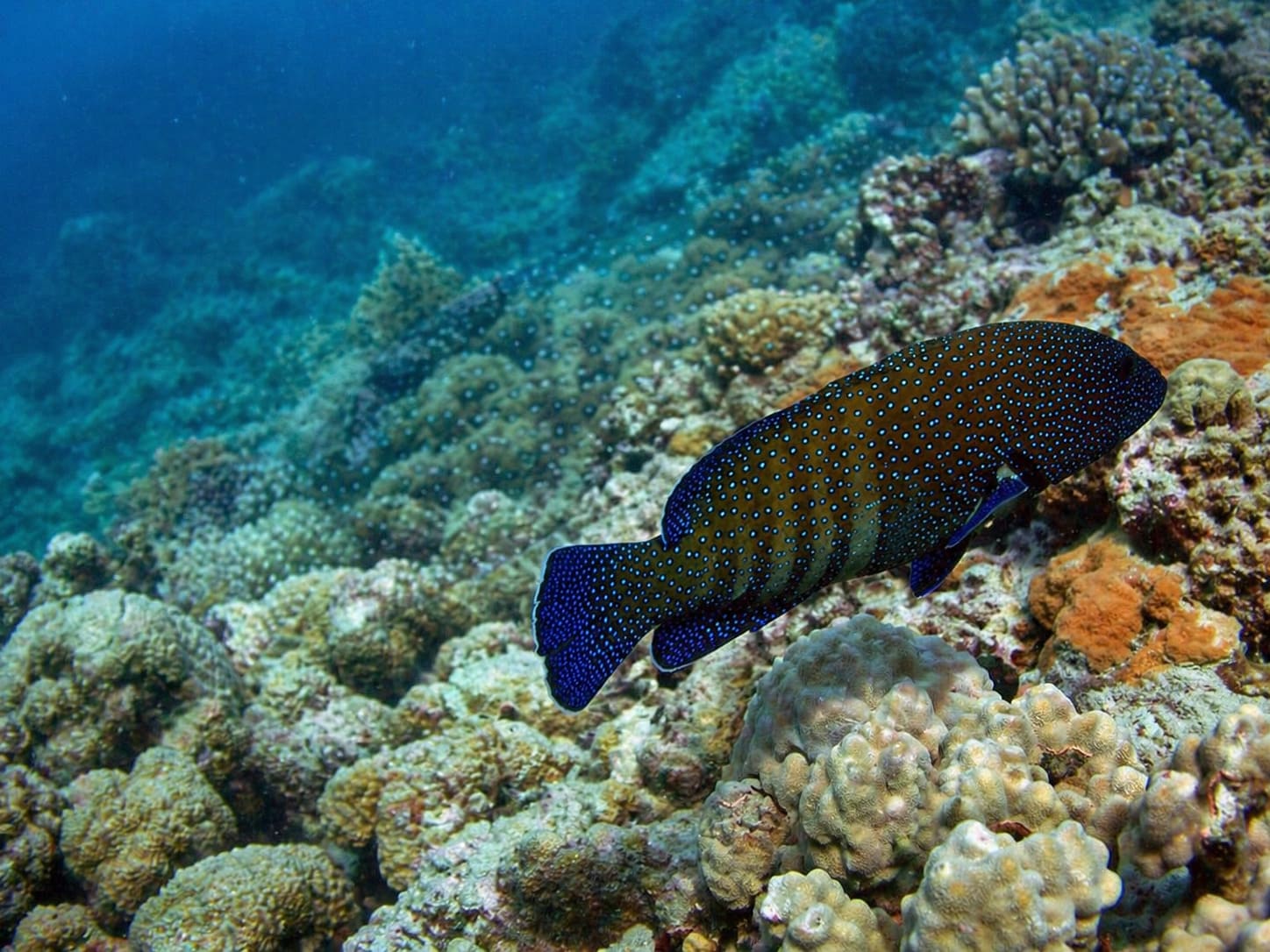
Hawaii Reef Fish Guide
Groupers
Groupers are heavy-bodied reef predators with large mouths, protruding lower jaws and a patient ambush style. In Hawaii, most groupers live near reef bottoms or deeper offshore areas, while the endemic Hawaiian Black Grouper is known as hapu'u.
Groupers Overview
Groupers are heavy-bodied predatory fish with large mouths, strong jaws and a usually solitary lifestyle. Many stay close to the bottom, where they rest near reef ledges, rocky areas, caves or deeper offshore structure. They are also called sea basses, and different species can live in shallow water or at depths of many hundreds of feet. Visitors can browse the broader Hawaii fish guide for more reef fish and marine animal profiles.
Most groupers have a thick body, protruding lower jaw and a tail fin with a straight or rounded back edge. Many species look dull or blotched, which helps them blend into rocky habitat. However, some species show brighter colors or more noticeable patterns. For more ocean background, visitors can also explore the broader Hawaii ocean life section.


Quick Facts About Groupers
- Family: Serranidae
- Other common name: Sea basses
- Hawaiian name for Hawaiian Black Grouper: Hapu'u
- Body shape: Heavy, thick-bodied and powerful
- Key feature: Large mouth and protruding lower jaw
- Habitat: Reef bottoms, rocky ledges, caves and deeper offshore waters
- Feeding style: Ambush predator that engulfs prey
- Diet: Fish, lobsters, octopuses, stingrays and other marine animals
How Groupers Hunt
Groupers do not usually chase prey for long distances. Instead, they stalk slowly or wait near cover until prey comes close. Then they open their large mouths quickly, creating suction that pulls water and prey inside.
This feeding method allows them to capture many kinds of animals. Depending on the species and size, groupers may eat small fish, lobsters, octopuses, stingrays and other reef animals. Very large species can take surprisingly large prey. Other reef predators to compare include barracudas, jacks, lizardfishes and sharks.
Size and Giant Species
Some groupers grow to enormous sizes. The Giant Grouper can reach about 9 feet in length and weigh up to 900 pounds. This species has such a large body and mouth that it often becomes the example people think of when discussing massive reef predators.
However, Giant Groupers are very rare in Hawaii. Most groupers seen or recorded in Hawaiian waters are much smaller than the largest individuals found elsewhere.
Groupers in Hawaiian Waters
Groupers occur in both shallow and deep habitats, but many prefer reef bottoms and offshore structure. The endemic Hawaiian Black Grouper is one important species in the Hawaiian archipelago. It occurs especially in the Northwestern Hawaiian Islands and carries the Hawaiian name hapu'u.
Because some grouper species live deeper or in remote areas, snorkelers may not see them as often as shallow reef fish. Divers may have better chances near ledges, caves or deeper reef slopes. Visitors planning reef time can also review Hawaii snorkeling, Hawaii beach safety tips and guided options such as Oahu snorkeling tours, Maui snorkeling tours, Kauai snorkeling tours and Big Island snorkeling tours.
Identification Notes
- Look for a thick, heavy body shape.
- Notice the large mouth and lower jaw.
- Watch for solitary behavior near the bottom.
- Check ledges, caves and rocky reef structure from a respectful distance.
- Expect many species to look blotched or camouflaged.
Diving and Viewing Tips
Groupers often rely on cover, so they may remain still near rocks or caves. Move slowly and avoid crowding them. In addition, never reach into holes or try to flush fish out of shelter, since this can stress wildlife and damage reef habitat.
With their powerful bodies, ambush feeding style and Hawaiian name hapu'u for the endemic Black Grouper, groupers are among the most impressive predators in Hawaii's reef and deepwater fish communities. Visitors interested in reef habitats can also read about the Hawaiian coral reef, Hawaii beach sand composition and marine debris in the Hawaiian Islands.