















Hawaii Population
The People of Hawaii
The astounding beauty of Hawaii is matched only by the beauty of its people, each contributing to the aloha spirit that makes Hawaii a place unmatched around the world. Hawaii is the embodiment of diversity, a veritable melting pot of cultures from near and far and everything in between. Hawaii's modern make-up of such grand diversity gives us a glimpse at the beginnings of settlement of the Hawaiian Islands by the Polynesians thousands of years ago.
Christian missionaries from New England arrived in the Islands in 1820, dramatically impacting the native Hawaiian population with disease and steadily growing the Caucasian or "haole" population. The present cultural mix is thanks in part to the pilgrimage of migrant sugarcane and pineapple workers from China, Japan, the Philippines, Korea, Portugal, Puerto Rico and other nations in the mid to late 1800s.


Today, the island of Oahu, which boasts more residents and visitors than all other Hawaiian islands combined (and even has more residents than the state of Alaska), is affectionately nicknamed "The Gathering Place." Samoans, Tongans, Hawaiians, Chinese, Japanese, Maori, Canadians, Tahitians, Vietnamese, Spaniards, Scottish, Irish, Italians and many other ethnicities combine to form the amazing lifeblood that characterizes Hawaii. Whatever island you are on, you are sure to meet a cast of characters with different backgrounds and with wisdom and stories to share.

With Hawaii's intriguing mix of cultures, it is not uncommon to hear a variety of languages being spoken on the streets, including Samoan, Portuguese, Japanese, Hawaiian, Chinese and Pidgin, a local dialect that combines a mix of Hawaiian and English languages with incorporated slang.
Population Steadily Growing
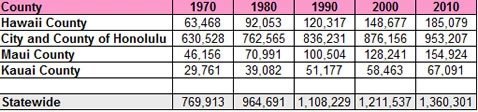
From 2000 to 2010, Hawaii's population grew by 12.3%, a statistic attributed largely to consistent migration to the Islands. Hawaii's current population is 1,360,301 with around 953,207 people (70%) living in the City and County of Honolulu.
Population Statistics:
Statistics courtesy of the U.S. Census Bureau
State of Hawaii
Population (2010 Census): 1,360,301 (1,211,537 in the 2000 Census)
Population Growth (since 2000 Census): 12.3%
Population Density (2010 Census): 211.8/sq mi, 81.8/sq km
Median age (2010 Census): 38.6 years
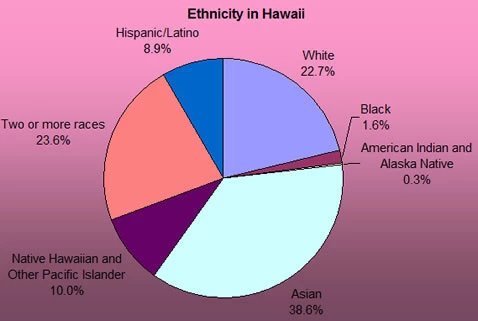
Ethnicity
White: 22.7%
Black: 1.6%
American Indian and Alaska Native: 0.3%
Asian: 38.6%
Native Hawaiian and Other Pacific Islander: 10%
Two or more races: 23.6%
Hispanic/Latino: 8.9%
Hawaii State and County Population
Hawaii Population Density:
| Oahu: | 1,594.9 persons per square mile 615.8 persons per square kilometer |
| Big Island of Hawaii: | 45.9 persons per square mile 17.7 persons per square kilometer |
| Maui: | 187.1 persons per square mile 72.2 persons per square kilometer |
| Kauai: | 121.2 persons per square mile 46.8 persons per square kilometer |
| Molokai: | 28.2 persons per square mile 10.9 persons per square kilometer |
| Lanai: | 22.2 persons per square mile 8.6 persons per square kilometer |
| Niihau: | 2.5 persons per square mile 1.0 person per square kilometer |
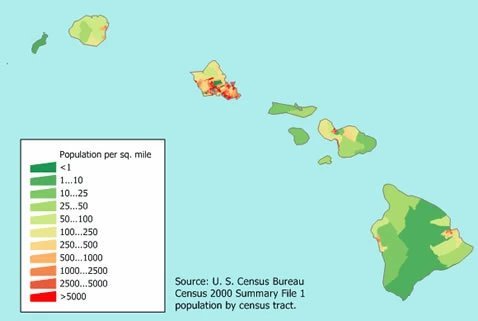
Map credit: Jim Irwin at en.wikipedia
Tourism in Hawaii
The late 1800s also marked the beginning of lucrative tourism in the Islands, an industry that grew rapidly when Hawaii became a state in 1959 and the jet airliner hit the skies. In 2011, about 7.3 million people from around the world visited Hawaii.
Military presence in Hawaii
As the gateway to the Pacific, Hawaii is home to a variety of military installations, creating a high military personnel population in the Islands. Military installations in Hawaii include:
Air Force Bases: Bellows Air Force Station, Hickam Air Force Base, Wheeler Army Airfield
Army Bases: Fort Shafter, Schofield Barracks, Tripler Medical Center, Pohakuloa Training Area
Coast Guard Bases: Station Maui, USCG ISC Honolulu (United States Coast Guard Integrated Support Command), Coast Guard Air Station Barber's Point
Marine Corps Bases: MCB Hawaii
Navy Bases: Barking Sands Missile Range, NCTAMS PAC (Naval Computer and Telecommuniations Area Master Station Pacific), Naval Station Pearl Harbor
Military personnel (July 2010): 47,410 military personnel, or 3.48 percent of Hawaii's total population
- Army 22,477
- Navy 10,810
- Marine Corps 7,767
- Air Force 4,805
- Coast Guard 1,551
