















Hawaii Government
Who Governs the Hawaiian Islands?
Government in Hawaii is similar to other U.S. states but also has several differences. The state constitution was modeled from the constitution of the Kingdom of Hawaii, modified to not conflict with the U.S. Constitution.
English and Hawaiian are official languages, though in practice, it is not required that all official documents be printed in each language, or that government officials be fluent Hawaiian speakers. Admission Day is a state holiday in Hawaii, observed on the third Friday in August.
Pre-Statehood Period
On August 12, 1898, sovereignty of Hawaii was formally transferred to the USA. A ceremony took place at Iolani Palace in Honolulu. Sanford Dole gave a speech as the newly appointed governor of the Territory of Hawaii.
The Hawaiian anthem, Hawaii Pono'i, was played as the Hawaiian flag was lowered and replaced by the American flag and the Star-Spangled Banner.

The Push for Statehood
Starting from around the turn of the century until after World War II there was a push for statehood, but Congress was reluctant at first because of social as well as political concerns. In 1947, the U.S. House of Representatives passed a statehood bill, but the U.S. Senate refused. Not until 1959, after Alaska became the 49th state, did Congress vote to let Hawaii enter the Union. Following Alaska's admission in January 1959, a new flag with 49 stars was designed and first flew over Independence Hall in Philadelphia on July 4, 1959. It would be the official flag for only a year. The 50-star flag became the 27th flag on July 4, 1960, and remains the official flag of the United States until today. President Dwight Eisenhower signed the bill on March 18, 1959, and the question was then proposed to the Hawaiian electorate, who voted for statehood on June 27, 1959, by a margin of 17-1. Hawaii became the 50th state on August 21, 1959.
Post-Statehood Period
Hawaii's constitution was drafted in 1950 and became effective in 1959 upon attainment of statehood. In 1969, the construction of a new state capitol was completed.
Hawaii's government is organized into three branches: Executive, Legislative and Judicial. A governor elected every four years heads the executive branch. The current governor of Hawaii is Neal Abercrombie. The Hawaii State Legislature has a Senate with 25 members elected for four-year terms and a House of Representatives with 51 members elected for two-year terms. The state of Hawaii elects two representatives and two senators to the U.S. Congress and has four electoral votes. The Supreme Court of Hawaii is the state's highest court. It consists of five justices.
Defense, tourism and food processing have been mainstays of Hawaii's economy, with the state playing an increasing key role as an economic, educational and cultural bridge between the U.S. and the nations of Asia and the Pacific. In the mid- to late 20th century, Hawaii faced the challenge of preserving the natural beauty of its environment, while accommodating a growing population and a thriving visitor industry.


Native Hawaiians Push for Sovereignty
A prominent political issue in recent years has been the achievement of some form of sovereignty by Native Hawaiians. In 1996, a majority of the Hawaii's roughly 200,000 descendants of indigenous Hawaiians voted to establish some form of self-government. In August 1998, the 100th anniversary of the U.S. annexation of Hawaii, protesters marched in Washington, D.C., demanding their full sovereignty from the federal government.
In July 2000, the movement received support in a rights bill introduced in Congress by Hawaii Senator Daniel Akaka. The Akaka Bill asked that Native Hawaiians be allowed to form their own government and have status similar to that of American Indians.
 Interesting
Facts about Hawaii's State Seal
Interesting
Facts about Hawaii's State Seal
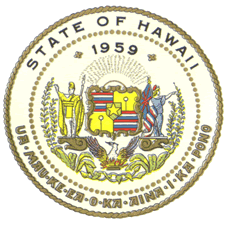
Hawaii's state motto, as displayed on the state seal, is "Ua mau ke ea o ka aina i ka pono" - "The life (sovereignty) of the land is perpetuated in (by) righteousness." King Kamehameha III made the phrase "Ua mau ke ea o ka aina i ka pono" a motto of the Hawaiian Kingdom on July 31, 1843. After that Queen Victoria made a public announcement that Hawaii's sovereignty was finally restored after the British occupation of Hawaii that lasted five months. On May 1, 1959, "Ua mau ke ea o ka aina i ka pono" became the official motto of the state of Hawaii. Here are some interesting facts about the state seal:
- 1959 is the date of statehood.
- The rising sun replaces the royal crown of the original coat of arms, which symbolizes the birth of a new state.
- King Kamehameha the Great and the Goddess of Liberty are holding the Hawaiian flag. They replace the two warriors on the royal coat of arms.
- The four stripes of the Hawaiian flag in each of the first and fourth quarters of the shield represent the eight main Hawaiian islands.
- Pulo'ulo'u, or tabu ball and stick, in the second and third quarters was carried before the king and placed before the door of his home, signifying his authority and power. In the seal it symbolizes the authority and power of the government.
- The phoenix, which is a symbol of death and resurrection, symbolizes the change from the monarchy to a freer democratic form of government.
- The eight taro leaves, flanked by banana foliage and maidenhair fern, are typical Hawaiian flora. Taro also had great religious significance.
Hawaii State Song - Hawai'i Pono'i
Written in 1874 by King David Kalakaua with music composed by Captain Henri Berger, the king's royal bandmaster.
| Hawai'i pono'ī Nānā i kou mo'ī Hui (Chorus) Hawai'i pono'ī Hawai'i pono'ī |
Hawai'i's own Hui (Chorus) Hawai'i's own Hawai'i's own |
