















Hawaii Ocean Channels
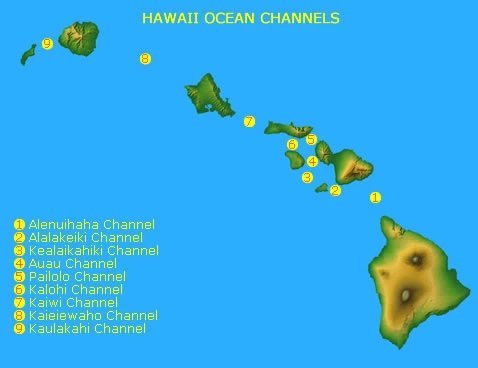
Here is an overview about each Hawaiian ocean channel, from southeast to northwest.
Alenuihaha ChannelThe Alenuihaha Channel lies between the Big Island of Hawaii and Maui. Its maximum depth is 6,810 feet (2,076 m) and it spans 29.6 miles (47.6 km). In the Hawaiian language, alenuihaha means "great billows smashing.
Alalakeiki ChannelThe Alalakeiki Channel lies between Kahoolawe and Maui, a 6.7-mile (10.8 km) stretch. Its maximum depth is 822 feet (251 m). Alalakeiki means "crying child" in Hawaiian.

Kealaikahiki Channel
The 17.8-mile (27 km) wide Kealaikahiki Channel separates the islands of Lanai and Kahoolawe. The channel's maximum depth is 1,086 feet (331 m). Kealaikahiki means “the road to Tahiti.” In the old Hawaii, voyages to foreign lands traveled through this channel. A boat heading directly straight down south from here would arrive in Tahiti, hence its name.
Auau ChannelThe 9.5-mile (15.3 km) wide Auau Channel is the most shallow and protected one in the Hawaiian Islands. It is no wonder that the Pacific humpback whales, which migrate to Hawaii from Alaska each year in the winter, prefer this channel to birth and raise their calves. The channel lies between Maui to the east and Lanai to the west. It is also protected by Kahoolawe to the south and Molokai to the north. Its depth is a mere 252 feet (77 m). In the winter months, many whale watching boats frequent this channel to view the whales. In the Hawaiian language, 'Au'au means “to take a bath,” referring to the channels bathtub-like conditions. The center of the Auau Channel is known as the Lahaina Roads. It used to be filled with whaling ships when the town of Lahaina on Maui's west shore was the capital of the whaling industry.
Pailolo ChannelThe Pailolo Channel lies between Maui and Molokai. Its maximum depth is 846 feet (258 m). Even though it spans just 8.8 miles (14.2 km), it is usually very windy and rough. Pailolo in Hawaiian means “crazy fisherman,” referring to any fisherman who would be crazy enough to try to navigate this tough channel.
Kalohi ChannelThe 9.2-mile (14.8 km) Kalohi Channel separates Lanai and Molokai. Its maximum depth is 540 feet (165 m). Strong winds and choppy seas are common in this channel. A British vessel, the Alderman Wood, got into trouble off Lanai's north shore in 1824 and sank. Two years later, the London, an American ship was purposely grounded here. After the end of World War II, grounding the ship here was seen as the most economical way to dispose of it. Up until today, the ship's hull can be seen resting on Lanai's aptly named Shipwreck Beach. Even though this channel has a rather turbulent history, its name means "the slowness" in the Hawaiian language.
Kaiwi Channel
The Kaiwi Channel, which is also known as the Molokai Channel, lies between Molokai and Oahu. Its maximum depth is 2,202 feet (671 m) and it spans 25.8 miles (41.5 km). It has a reputation of being one of the toughest ocean channels in the world because of the usually strong winds, strong currents and large swells. It is also known for being very unpredictable. One moment it may be calm as calm as a lake and then it suddenly it turns into a raging roller coaster ride. The annual Molokai Hoe outrigger canoe competition takes place in this channel. More than 1,000 expert paddlers, who come to Hawaii from around the world, participate in this event. The literal meaning of kaiwi in the Hawaiian language is "the bone.


A submerged shield volcano called Penguin Bank lies to the west of Molokai and within the Kaiwi Channel. It is an area of relatively shallow water. The bank is about 10 miles (16 km) wide, 20 miles (32 km) long and the water depth is around 200 feet (60 m). There has been ongoing talk to build wind turbines on Penguin Bank.
Kaieiewaho ChannelThe Kaieiewaho Channel, also known as Kauai Channel, separates Oahu and Kauai. It is 72.1 miles (116 km) wide and at a maximum depth of 10,890 feet (3,319 m) the deepest of the channels between the main Hawaiian Islands. Ka'ie'ie Waho means "outer Ka'ie'ie."
Kaulakahi ChannelThe Kaulakahi Channel lies between Niihau and Kauai. It is 17.2 miles (27.7 km) wide and 3,570 feet (1,088 m) deep. In the Hawaiian language, kaulakahi means "the single flame (or streak of color)."
