















Hawaiian Flag
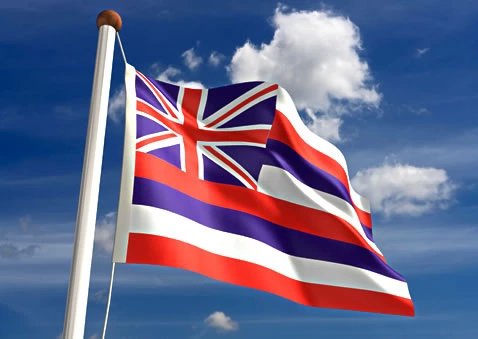
The Hawaiian Flag
The Hawaiian culture is notorious for its incorporation of deeply rooted symbolism and multiple-fold meanings. Ka Hae Hawaii, or the Flag of Hawaii, is no exception. Ka Hae Hawaii is a beautiful and symbolic representation of the many facets of Hawaii's rich and unique history. The Hawaiian flag symbolizes the Kingdom of Hawaii, the republic of Hawaii, its previous status as a territory and its current status as a member of the United States. As one of the oldest flags still in use, the Hawaiian flag flies proudly in many locations throughout the islands, including numerous government buildings, schools and private homes.

The Hawaiian Flag History
The story of how the Hawaiian flag came about is an interesting one. Although historians may disagree on the exact details, it is settled that Kamehameha the Great (Kamehameha I) was responsible for its inception.
We can better understand the meanings behind the Hawaiian Flag by learning a little about the King who oversaw its creation. Kamehameha I ruled successfully, creating a single sovereign nation and securing recognition by worldwide major powers. Before King Kamehameha I's rule, the individual islands were governed by separate chiefs. King Kamehameha I was a skilled warrior credited with conquering and uniting the eight major Hawaiian Islands.


The King was a determined ruler, dedicated to protecting the welfare and sovereignty of his people. He did not allow non-Hawaiians to interfere in island politics, but he played the role of ambassador well and strived to form harmonious relationships and alliances. His ruling prowess and ability to be a symbol of goodwill helped the Hawaiian Islands to become an important center for industry - during his reign, fur and sandalwood trade and coffee and pineapple exporting were significantly kick-started.
Relationships with Britain - and Britain's status as a protectorate - were very important to King Kamehameha I. In 1793, a portion of the islands were ceded to the UK in communication with representative Captain Vancouver, a deal that was never really acted upon by the British. Some say today's Hawaiian flag was created after controversy surrounding the waving of both the Union Flag and American Flag. Each side opposed the flying of the other's flag, so a compromise was reached. The Hawaiian flag is notoriously seen as a melding of the U.S. and British flags. When the new Kingdom of Hawaii flag was introduced, it was not long before the UK, France, the U.S. and Japan granted their official recognition of the icon.
The Hawaiian Flag Design
In 1816, Kamehameha the Great commissioned the design to an officer of the Royal Navy. The UK influence on the design is obvious - in the left upper corner is the duplicated Union Flag, a symbol of Hawaii's alliance with the British. A second-fold meaning to the inclusion of the Union Flag is the symbolic representation of the alia, a chiefly symbol created by crossing two spears rooted with an upright spear.
The eight horizontal stripes that make up the body of the flag represent the major Hawaiian Islands of Oahu, Maui, Lanai, Kauai, Kahoolawe, Molokai, Niihau and the Big Island of Hawaii. The first version was said to have contained seven horizontal stripes as opposed to today's eight stripes. And some say that the alternating white, red and blue stripe colors were placed by mistake; that they were intended to in a sequence of red, white and blue.
Hawaii's flag means many things to different observers. Hawaii has the distinction of being the only state to have been formerly ruled by a monarchy. The Hawaiian flag not only represents Hawaii's struggles and progress in modern times, it also continues to pay homage to a time when the Hawaiian Kingdom allowed the alii (chiefs) to govern their people with absolute sovereignty. Many Hawaiians recognized this flag as a symbol of independence and a representation of the monarchy's opposed overthrow, pledging eternal allegiance to Hawaii as a sovereign nation.
The American overthrow of the independent nation of Hawaii was not the first time sovereignty had been challenged. In 1843, British Lord Paulette claimed stake in the islands, only to be rebutted by the country's Admiral Thomas, who reaffirmed Hawaiian independence and re-granted recognition of the Hawaiian flag on July 31 of the same year. After this scuffle, Kamehameha III spoke the words that were to become the Hawaii state motto: "Ua mau ke ea ka aina i ka pono," the life of the land is perpetuated in righteousness. On May 20, 1845, Ka Hae Hawaii was dedicated at the opening of the Legislature of the Hawaiian Kingdom.
Hawaiian Flag Day
July 31st was named Hawaiian Flag Day by the former Governor John D. Waihee III, the first of Hawaiian descent to govern under the realm of statehood. Annual celebrations allow Hawaiian residents to celebrate the complex meanings represented in this historic symbol.
Ka Hae Hawaii Chant (excerpt)
O 'oe ho'i e ka Hae e welo nei
Thou art the Flag a-waving
Ka pua hanohano o Hawai'i e
The dignified symbol of Hawai'i
Ua kau ia mai e Kamehameha nui
Appointed by Kamehameha the Great
Me ka Ihe i ka lima, a me ka ikaika pu,
With spear in hand, with accompanying strength
E welo 'oe ma Hawai'i me Ni'ihau e ho'omalu pu
Wave thou from Hawai'i to Ni'ihau and protect
Malo iho o kou mau eheu,
Under thy (spreading) wings
E ikea'i ka maluhia o Hawai'i nei,
That Hawai'i be peacefully known
E kona Mo'i a Maka'ainana pu
By her King and Common people
The Hawaiian flag, flying high for 180 years and counting, continues to remain a symbol of pride and distinction. As an emblem of the state of Hawaii and a marker for the Nation of Hawaiian People (Ka Lahui Hawaii), the Hawaiian flag ties together residents of all ethnicities and backgrounds, who choose to call these wonderful islands home.
