
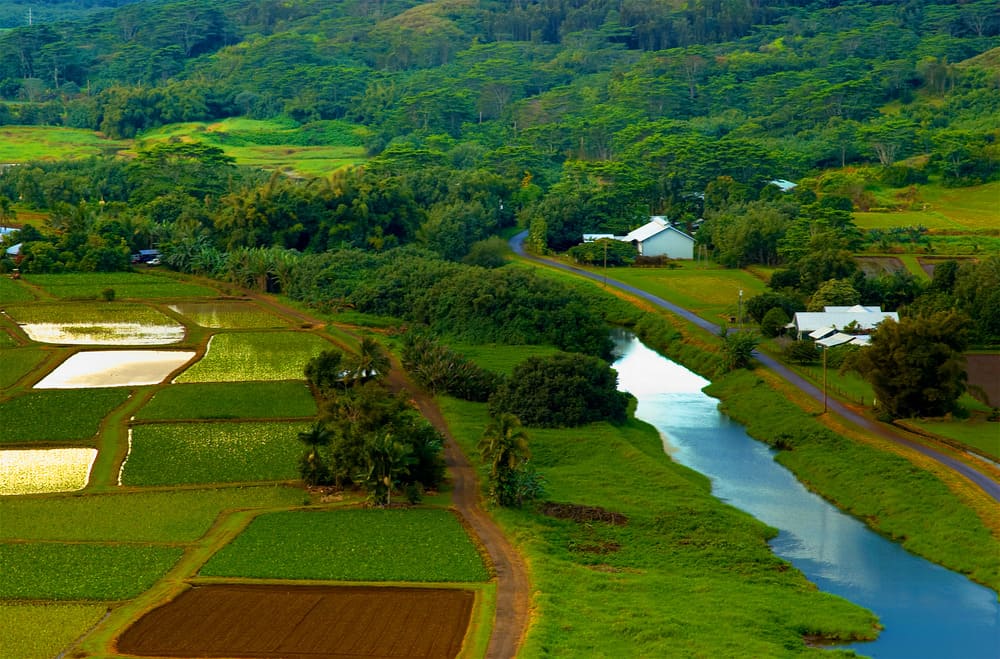

Many Diverse Crops
Thanks to Hawaii's mild, year-round climate, the Islands support many types of agriculture. Hawaii's farms produce crops, nursery plants, livestock, honey, aquaculture products, tropical fruit, specialty crops and value-added foods. According to the 2022 Census of Agriculture, Hawaii had 6,569 farms, about 1.053 million acres in farms and $673.8 million in market value of agricultural products sold.
When many people think about agriculture in Hawaii, the crops that come to mind are sugarcane, pineapple, macadamia nuts and coffee. These crops are important to Hawaii's agricultural history, but today's farm landscape is broader. Farmers also grow ginger, banana, cacao, taro, sweet potato, lettuce, tropical flowers, nursery plants, seed crops, herbs and many kinds of fruit.
History
When the first Westerners came to the Hawaiian Islands in 1778, they found that Native Hawaiians had a wide array of food available. The Islands had pig, chicken, ginger, kawa, taro, ti, sugarcane, banana, coconut, sweet potato and breadfruit.
These early crops included canoe plants, useful plants brought by Polynesian voyagers for food, medicine, fiber, shelter and ceremony. Taro, or kalo, was especially important because it was used to make poi and held deep cultural meaning in Native Hawaiian life.
Between 1790 and 1870, sandalwood and later whaling were both major parts of Hawaii's changing economy. They are no longer part of Hawaii's agricultural industry, but both subjects remain important in Hawaii's history.
Over the next 100 years, Westerners and immigrant plantation communities brought in many other plants and animals that became part of Hawaii's agricultural story.
Sugarcane
Sugarcane was growing in Hawaii long before Captain Cook came to the Islands in 1778. As early as 1802, people on Lanai were reportedly using stone rollers to crush the sweet juice from the sugarcane.
It wasn't until 1834 that the first sugar plantation went up on Kauai. Ladd & Company was granted the use of 980 acres from King Kamehameha III for growing and harvesting sugarcane.
Hawaii had a favorable climate for this crop, and the industry boomed. By 1959, one out of every twelve people in the work force was employed by the sugar industry.
Today, large-scale sugar production no longer dominates Hawaii agriculture. Hawaii's last major sugar plantation ended operations in 2016, closing an era that shaped land use, labor, immigration, communities and local culture across the Islands. Sugarcane still grows in limited ways, including cultural, small-farm, research and specialty uses, but it is no longer the plantation-scale industry it once was.
Many visitors once mistook the harvesting of sugarcane for a huge field fire. In Hawaii this was called "burning cane." When cane was burned, locals often hoped for the trade winds to pick up and sweep the smoke and ash from the area. During this step of the harvesting, small flecks of black ash could cover parts of nearby communities.
Some people reported that their allergies were worse when the cane was burning. If you have severe allergies or asthma and plan to visit areas with agricultural burning or smoke, discuss the possibility of a negative reaction with your doctor before traveling.
Macadamia Nuts
The macadamia nut tree was brought to Hawaii from Australia in 1882. For about forty years, macadamia trees were raised as ornamental trees because of their beauty. Over time, macadamia nuts became one of Hawaii's best-known agricultural products.
The first macadamia nut plantation was set up in 1921, but it wasn't until the 1950s that the crop became profitable. Hawaii still grows macadamia nuts and produces many island-branded products, though it no longer supplies most of the world's macadamia nuts.
You will find many types of macadamia nut products during your Hawaii vacation. The macadamia nut is versatile. It tastes good roasted and salted, in candies, in baked goods, on fish and poultry and as an oil.
Pineapple
It is documented that pineapple was brought to the Islands by King Kamehameha I's Spanish advisor, Don Francisco de Paula y Marin, in 1813. However, it is speculated that as early as 1527, pineapples may have come to the Islands when a Spanish ship was wrecked off the South Kona coast of the Big Island. Many things washed ashore in this wreck, and pineapple may have been one of those things.
Pineapple became one of Hawaii's largest and most profitable crops after its introduction. In 1898, Alfred W. Eames of California formed what would become Del Monte Fresh Produce. In 1901, James Drummond Dole formed Dole Hawaiian Pineapple Company. In 1909, Maui Land and Pineapple was formed. These companies became giants in the pineapple industry. By 1930, nine million cases of pineapple were exported out of Hawaii by eight different canneries. In the 1960s, Hawaii was responsible for much of the world's pineapple.
Today, pineapple is still grown in Hawaii, but on a much smaller scale than during the plantation era. It remains an important symbol of Hawaii's agricultural history, and visitors can still find fresh island-grown pineapple, pineapple products and farm-related visitor stops on some islands.
Travelers who want to bring agricultural products home should check current airport inspection rules before packing fresh fruit, plants, seeds, flowers or other farm products. Rules can change, and some items require inspection or may not be allowed.
Coffee
The first coffee plant was introduced to Hawaii through King Kamehameha I's Spanish advisor in 1813. In 1828, the first coffee tree was planted in Kona on the Big Island of Hawaii by a missionary. Thus, the exquisite taste of the coveted cup of Kona coffee had begun.
In the 1930s, coffee became a commercial crop in Hawaii. Today, coffee remains one of the state's signature agricultural products, especially in Kona, Ka'u, Hamakua, Puna, Maui, Kauai and other growing areas. Hawaii coffee benefits from volcanic soils, varied elevations, sunny mornings, cloudy afternoons and small-farm growing traditions.
While on vacation, beware of buying coffee marked as "Kona Blends." Many blends contain only a small percentage of Hawaii coffee in the bag. While true Kona coffee can be pricey, it is a rare treat. Make sure to savor every sip.
Other Hawaii Crops and Farm Products
Hawaii agriculture continues to diversify. Farmers grow cacao for local chocolate, tropical fruit such as mango, lychee, rambutan and papaya, and many vegetables, herbs and flowers for local markets. Nursery plants, seed crops and floriculture also remain important parts of the agricultural economy.
Ranching is another part of Hawaii agriculture. Cattle, horses and paniolo traditions have long been tied to places such as Hawaii Island, Maui and other rural areas. Livestock, eggs, honey and aquaculture also contribute to the state's farm economy.
Supporting Local Agriculture
Visitors can support Hawaii agriculture by shopping at farmers markets, buying island-grown products, visiting farm tours and choosing restaurants that use local ingredients. Buying local helps farmers, keeps more money in island communities and gives travelers a better taste of Hawaii's working farms.


