

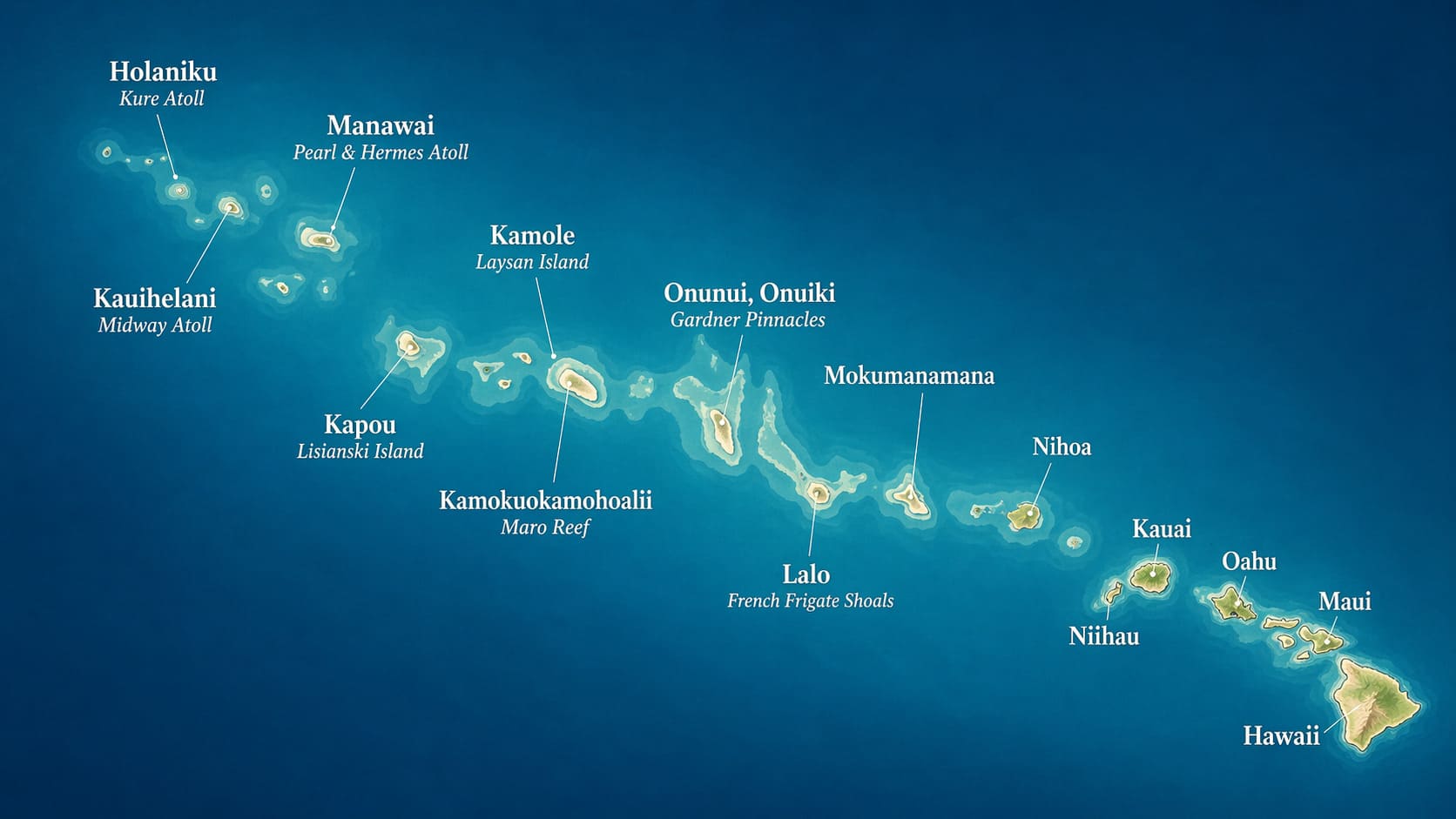
Kuaihelani, Midway Atoll
Midway Atoll
Midway Atoll, or Kuaihelani, is a remote refuge and national memorial known for World War II history, millions of seabirds, monk seals, sea turtles and protected reef habitat.
Ronen Zilberman, Associated Press
As its name implies, Midway Atoll lies about half way between North America and Asia, like a stepping stone mid-way. Midway Atoll is also known as Midway Island or Pihemanu
in the Hawaiian language. Encompassing 2.4 square miles (6.2 km²), the circular-shaped atoll consists of a ring-shaped barrier reef and a few sand islets. The three main ones are Sand Island, Eastern Island and Spit Island, located on the southern end
of a lagoon and home to almost two million birds.
Midway is probably the best known island in the Northwestern Hawaiian Island chain. While it is part of the Hawaiian archipelago, Midway is legally not part of the state of Hawaii. The Midway Islands are administered by the U.S. Fish and Wildlife Service. The atoll has a small population of researchers and administrators (less than 100) and there is a visitor's program, which allows small groups of visitors to learn about and experience Midway's unique ecosystems.
In 1859, Captain Brooks sailed to Midway Atoll and after that, the U.S. annexed it. The atoll was the country's first insular possession outside the continental U.S. In 1870, the U.S. recognized the strategic importance of Midway and began clearing a southern channel into the lagoon to create a port on Sand Island. Midway was later (in 1903) an important link in cable communications and a transpacific Panamerican seaplane stop (in 1935). In 1940, the work to build a military facility on the atoll began.
Midway Atoll became even more popular after the Battle of Midway, fought in World War II, from June 4 to 6 in 1942, when a small U.S. task force surprised and defeated the Japanese invasion fleet that was bound for the atoll. Midway Atoll was designated as the National Memorial to the Battle of Midway in 2000.
Over the years, Midway Atoll has been altered extensively by humans. The atoll has 20 miles (32 km) of roads, 4.8 miles (7.8 km) of pipelines, a port on Sand Island and a runway, about 8,000 feet (2400 m) long.
Almost two million birds of 19 species nest on Midway Atoll. Species include Laysan albatrosses (the atoll is home to the largest Laysan albatross colony in the world), black-footed albatrosses, white terns, red-tailed tropicbirds, shearwaters, black and brown noddies and Bonin petrels.
Seventy-five percent of Midway's plant species were introductions, including exotic vegetables, weeds, ornamental shrubs, coconut palms and ironwood. The marine life is abundant. More than 250 fish species can be found here, including hapuupuu (the Hawaiian grouper), kumu (goatfish), ulua (jack) and sharks. There are also many dolphins, turtles and monk seals. Moreover, 16 stony coral species have been reported.
Courtesy of Northwestern Hawaiian Islands Multi-Agency Education Project


Frequently Asked Questions
Where is Midway Atoll located?
Midway Atoll is located near the far northwestern end of the Hawaiian archipelago, northwest of the main Hawaiian Islands. It lies within Papahanaumokuakea Marine National Monument.
Is Midway Atoll part of Hawaii?
Midway is part of the Hawaiian archipelago, but it is not legally part of the State of Hawaii. The U.S. Fish and Wildlife Service manages the refuge and national memorial.
Why is Midway Atoll historically important?
Midway was the site of the Battle of Midway in June 1942, a major turning point in World War II's Pacific War. The atoll is now also the Battle of Midway National Memorial.
What wildlife lives on Midway Atoll?
Midway supports Laysan albatrosses, black-footed albatrosses, Bonin petrels, white terns, tropicbirds, Hawaiian monk seals, green sea turtles, dolphins, reef fish and corals.
Can visitors go to Midway Atoll?
No public visitation is currently allowed. Access is limited to activities that directly support airfield operations and conservation management of the refuge, memorial and monument.
Why is Midway famous for albatrosses?
Midway supports the world's largest Laysan albatross colony. Each year, huge numbers of albatrosses return to the atoll to nest, raise chicks and continue their long life cycles over the Pacific.