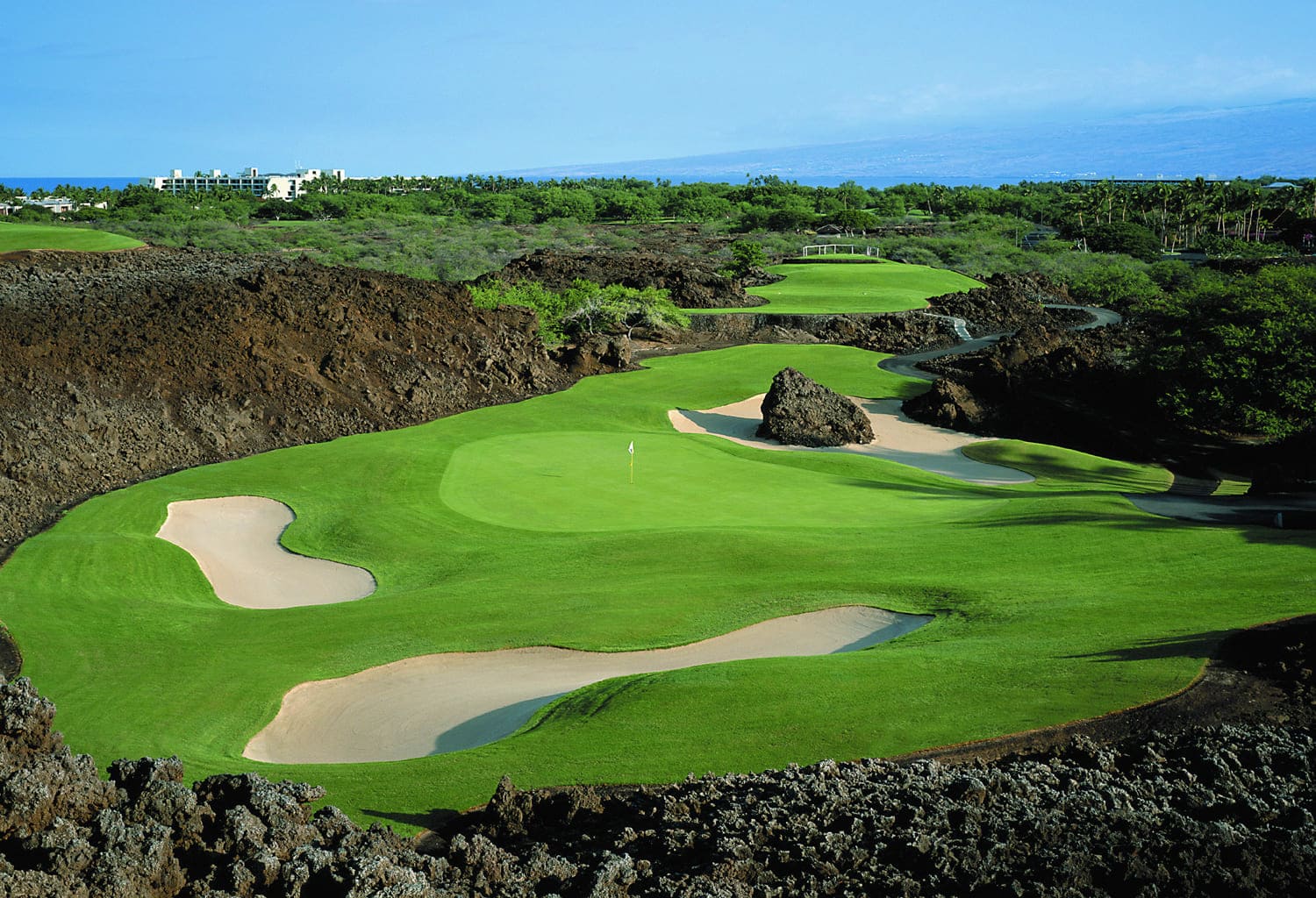
Mauna Lani Resort - North Course, Big Island
The North Course at the Mauna Lani Resort is one of the resort’s two championship golf courses, the other being the South Course. While both courses are design masterpieces and present players with considerable challenge, each course is strikingly different from the other, both geographically and in terms of player experience. The kiawe trees lining the fairways of the North Course and the markedly different terrain make this course appear significantly dissimilar to the South. The North Course has rapidly become a hugely popular tournament venue on the Big
Island and is bordered on its northern side by a protected archaeological district of some 230 acres. Feral goats can be found roaming the length of the course during the day.
Built on a lava bed, the rolling terrain of the 18-hole, par-72 North Course is interspersed at various intervals by Kiawe (mesquite) forests that come into play at several holes. The course provides plenty challenge for players of all abilities. However, most holes have up to five different tee options, so this gives players plenty choice to counteract the course’s many challenges. North Course has its share of water hazards, with several adjoining the ocean. The course’s signature hole is the 140-yard 17th. This par-3 plays from an elevated tee downwards to a lava-surrounded green. Although the playing distance is short, it can be difficult to gauge because of the elevation. But this position does provide players with a good photo opportunity!
A comprehensive range of facilities awaits those who choose to use the North Course at Mauna Lani Resort. As well as golf carts and a club rental service, there are practice facilities with driving range and putting green. Lessons and clinics are available from the resort’s professionals for beginners and existing players in all aspects of the game. The pro shop offers a wide selection of golf-related merchandise, catering for almost every requirement. The Golf Clubhouse is the place to go for anyone in need of refreshments after a challenging round. Aside from the Clubhouse, Mauna Lani resort offers several dining options, with the CanoeHouse being the resort’s signature restaurant. The resort also caters for meetings, weddings, and just about every type of event.
Key Features
Reviews
Reviews and Ratings
Share the first review
Have you visited Mauna Lani Resort - North Course? A few thoughtful details can help another traveler.
Been here? Share your experience
Map
Location, Parking and Directions
Mauna Lani Resort North Course is located within the Mauna Lani resort area on the Kohala Coast of Hawaii Island. Golf check-in is reached from the resort roads off Queen Kaahumanu Highway, with parking in the golf area near the clubhouse.
Photos
Mauna Lani Resort – North Course Photos
Photos of Mauna Lani Resort North Course show kiawe-lined fairways, lava-rock edges, resort golf greens, ocean views, the downhill 17th hole and the dry Kohala Coast setting.