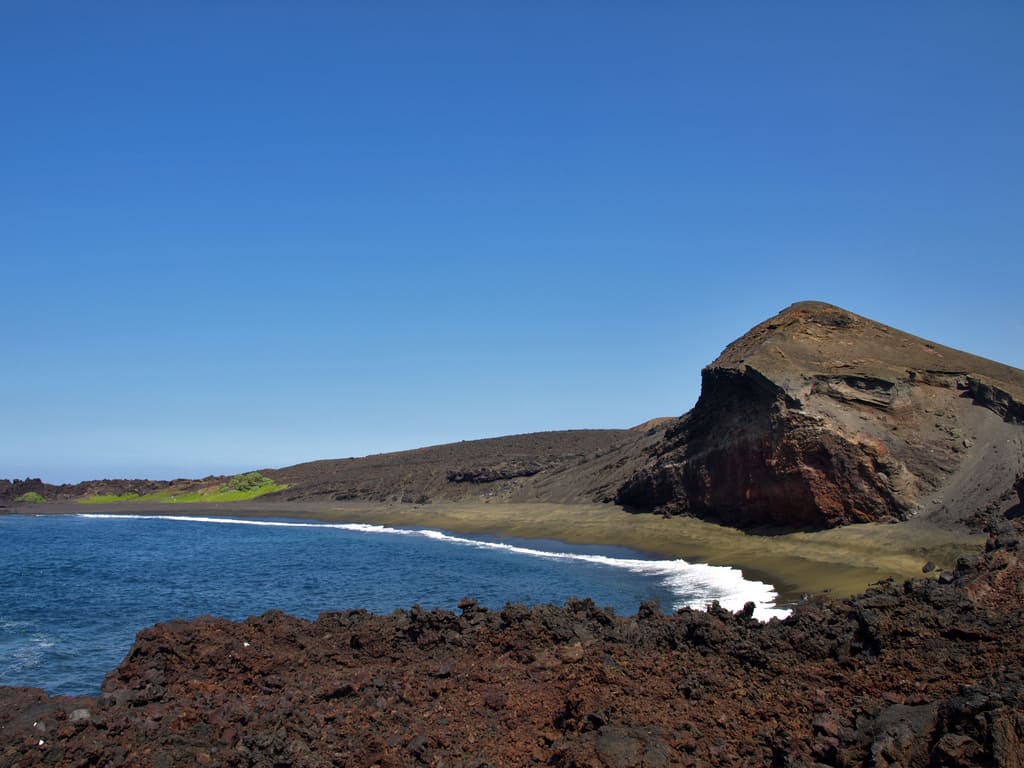
Road to the Sea Black Sand Beach, Big Island
The Road to the Sea, located on the Big Island's southwestern coast, is one that's hardly traveled, and it's easy to see why. The six-mile (9.7 km) trail is dotted with sharp lava rocks, surrounded by steep ledges and riddled with cracks and potholes. But those who make it here are well-rewarded, for at the end of this path lie a few black and green sand beaches that are surrounded by nothing but black lava rocks. On a sunny day, the coast has a striking look with its greenish sand, deep blue water and surrounding black cliffs.
But getting here is definitely an adventure in itself. The first 3 miles (4.8 km) of the road are doable even in a regular car, but after that the road is rough and steep in places, so a four-wheel drive vehicle is necessary to navigate it (or you can park here and hike the final 3 miles to the beach).
It's commonly called the Road to the Sea Black Sand Beach, but there are actually two beaches at the end of the road. Neither has an official name, but both are known for their black and green sands. The green comes from crushed olivine crystals, a less-polished variety of peridot. It is a semi-precious gemstone, brought to the surface by past volcanic activity and the erosive force of the ocean. The ancient Hawaiians considered olivine (green sand) to be the tears of the volcano goddess Pele, and they used the green sand in healing ceremonies. The sand pieces are too small to be considered gemstones, but occasionally a lucky beachgoer finds a bigger piece.
The two beaches are fairly small, between 50 and 100 feet (15-30 m) long. The green sand has a slightly darker hue here than at Papakolea Beach (near South Point), which is the most popular green-sand beach on the Big Island. There are no lifeguards in this area, so if you want to swim, snorkel or surf, keep in mind that the ocean bottom drops off quickly and strong currents can be present, especially during times of high surf. Fishing is a popular activity here, especially in the spring and summer when the fish swim closer to shore. The main catch is ulua.
Key Features
Beach Activities
Activities
Beach Facilities
Facilities
Reviews
Reviews and Ratings
Visitor rating
2 rated reviews
Been here? Share your experience
Visitor experiences
Newest firstDoug
Thu Jul 13, 2017
Perry Oslund
Sun Mar 11, 2012
The street sign has been removed from the entrance on 11, a sign that locals are keeping tourists out.
Asking directions at a local store resulted in "No beach out there".
Summary - one of the best spots to enjoy a peaceful day at a green sand beach without the crowds. Bring your beverages because there is nothing out there but you. Also, a truck is in the surf where an old path wound by the sea. Avoid that trail...
Map
Location, Parking and Directions
Road to the Sea Beach is on Hawaii Island's southwest coast, reached from Highway 11 in the Ka'u District. The route to the shoreline is a rough lava road that leads through remote terrain before reaching the black-and-green-sand beaches near the ocean.
Photos
Road to the Sea Beach Photos
Photos of Road to the Sea Beach show the rough lava road, black and green sand, remote shoreline, ocean views and rugged Ka'u coast scenery.