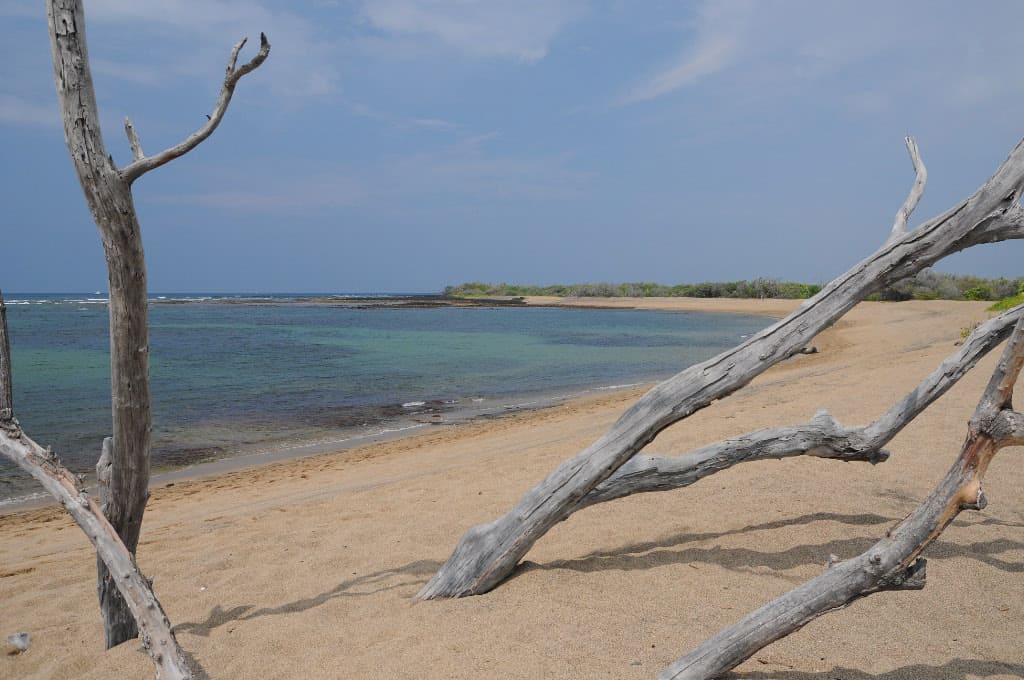
Honokohau Beach, Big Island
Honokohau Beach, located on the Big Island’s west shore, is a long salt-and-pepper sand beach, with fragments of ground-up seashells, coral and lava rock. There’s a low lava shelf at the water’s edge that lines most of the shore. The nearshore ocean bottom is shallow and rocky, and an offshore fringing reef shelters the beach from strong surf and currents. This is a good place for snorkeling.
A little inland near the northern end of the beach, there is a trail that leads across a lava field to a brackish-water pool, known as Queen’s Bath. It’s a spring-fed lava pool that some people use to rinse off after a swim in the ocean. To get here from the northern end of Honokohau Beach, walk approximately 600 feet (180 m) north until you reach a rock wall. From here, walk toward the mountains (toward the rock mounds) until you reach the pool, which is located right behind the rock mounds.
Honokohau is one of the many beaches that form Kaloko-Honokohau National Historical Park. This 1,160-acre (4.7 sq. km) park has important archaeological sites and artifacts, including ancient petroglyphs (rock carvings), temples, burial sites, trails, house platforms and three fishponds – Aiopio, Aimakapa and Kaloko. Together, these features show that this area once supported a Hawaiian settlement of several hundred people.
Key Features
Beach Activities
Activities
Beach Facilities
Facilities
Reviews
Reviews and Ratings
Visitor Reviews
Be the first to review Honokohau Beach.
Been Here? Add your Review
Map
Location, Parking and Directions
Honokohau Beach is located in Kailua-Kona within Kaloko-Honokohau National Historical Park, about 3.7 miles north of Kailua-Kona. From Highway 19, turn toward Honokohau Harbor at Kealakehe Parkway, park near Maliu Point and follow the shoreline toward the beach.
Photos
Honokohau Beach Photos
Photos show Honokohau Beach, salt-and-pepper sand, lava shelves, reef-sheltered water, shoreline trails, Queen's Bath area and Kaloko-Honokohau coastal scenery.