

Holoikauaua, Pearl and Hermes Atoll
Pearl and Hermes Atoll
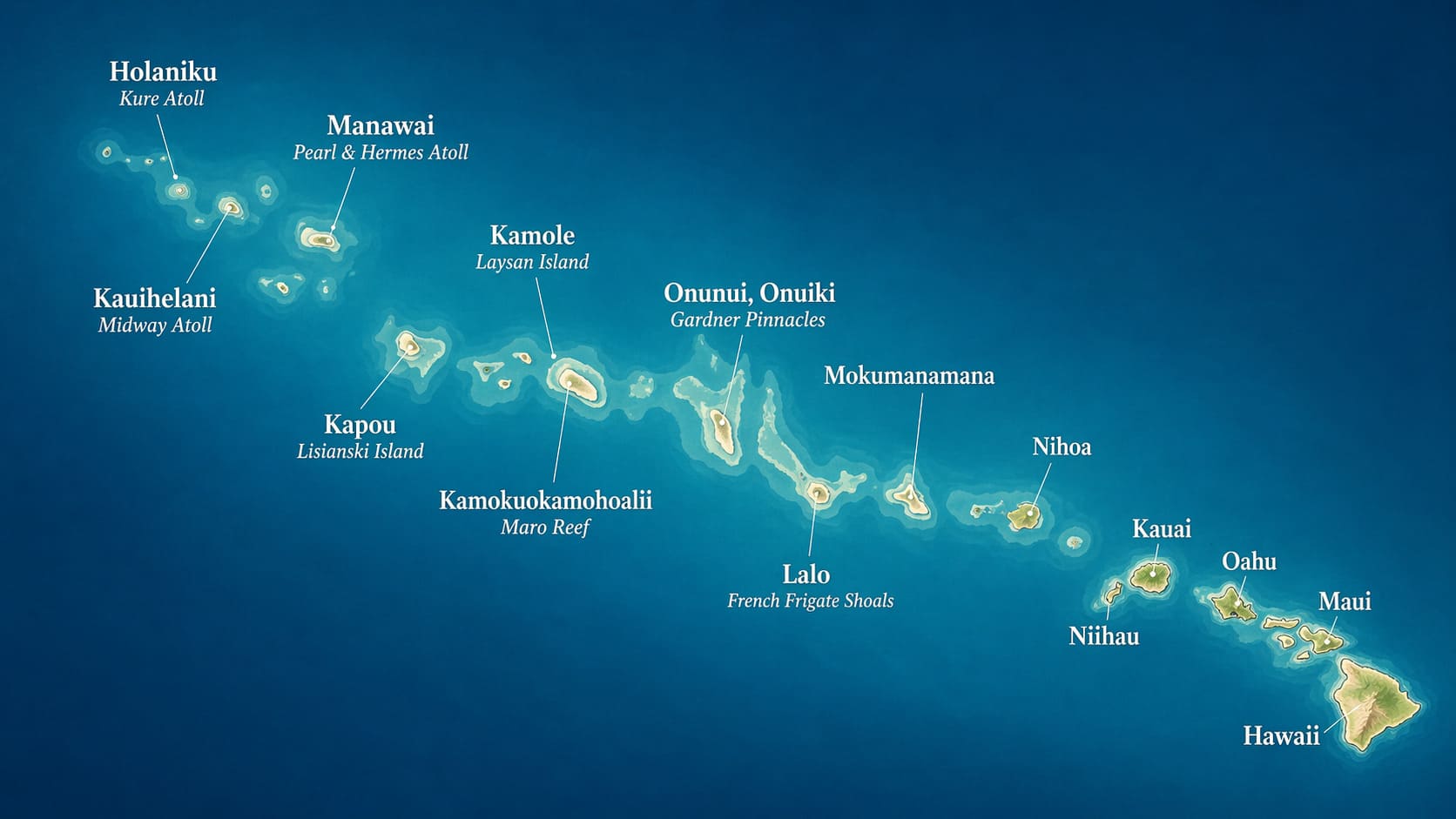
Pearl and Hermes Atoll, or Holoikauaua, is a remote Northwestern Hawaiian atoll known for sandy islets, seabirds, monk seals, sea turtles, shipwreck history and vast reef habitat.
NASA
Completely devoid of vegetation except for some species of grasses, the Pearl and Hermes Atoll (Holoikauaua) is primarily underwater and consists of only a few small sandy islets (seven of them are above sea level) that are contained within a lagoon and surrounded by a reef. While the total land area is just 0.139 square miles (0.359 km²), the surrounding reef is extensive, covering 450 square miles (1,165 km²). The atoll's highest point is just 10 feet (3 m) above sea level.
The Pearl and Hermes Atoll was discovered in 1822 by two English whaling ships, the Pearl and Hermes, which wrecked on the reef during a storm. Because the atoll has such a small land area, it was for the most part spared from the impact that miners and feather hunters had on some of the other Northwestern Hawaiian Islands. In 1854, King Kamehameha III made the atoll part of the Hawaiian Kingdom.
In 1927, as Captain Anderson was fishing for tuna, he discovered pearl beds within the lagoon. So for two years in the late 1920s, black-lipped pearl oysters were harvested to make buttons from their shells. However, the oysters were over-harvested and nearly eliminated, so in 1929, the harvesting of oysters was prohibited. The atoll was later declared a bird sanctuary. In 2006, the atoll was declared part of the Northwestern Hawaiian Islands National Monument.
At present, about 160,000 birds from 22 species have made the atoll their home. Species include black-footed albatrosses, Tristram's storm petrels, little terns and the Laysan finch.
Dry grasses, herbal plants and vines grow here. These plants are salt-tolerant and recover after the frequent floods on the islands. As for marine animals, the fish are abundant
here. In fact, the Pearl and Hermes Atoll has the highest number of fish species and the highest standing fish stock in the Northwestern Hawaiian Islands. Species include Galapagos sharks, sandbar sharks, saber squirrelfish, eels, ulua (big jacks), aweoweo (bigeyes), uhu (parrotfish), angelfish and many lobsters. Also, Hawaiian monk seals and sea turtles breed and feed at the atoll, and the atoll is also a mating area for spinner dolphins.
Several sponge species have been found in the reef. Some of these may even be new to science. Also, 33 species of corals have been identified here. Even though the Pearl and Hermes atoll experienced less human impact than some of its neighbor islands, one problem remains up until today - marine debris. In 2003, over 90 tons of washed ashore marine debris was removed from the atoll.
Courtesy of Northwestern Hawaiian Islands Multi-Agency Education Project


Frequently Asked Questions
Where is Pearl and Hermes Atoll located?
Pearl and Hermes Atoll, or Holoikauaua, is located in the Northwestern Hawaiian Islands, more than 1,000 miles northwest of Honolulu. It is part of Papahanaumokuakea Marine National Monument.
What is Pearl and Hermes Atoll known for?
The atoll is known for its small sandy islets, large reef system, seabird colonies, Hawaiian monk seals, green sea turtles, abundant fish life and shipwreck history.
How did Pearl and Hermes Atoll get its name?
The atoll was named after two English whaling ships, the Pearl and the Hermes, which wrecked on the reef during a storm in 1822.
What wildlife lives at Pearl and Hermes Atoll?
The atoll supports seabirds, Hawaiian monk seals, green sea turtles, reef fish, sharks, lobsters, corals, sponges, algae and many invertebrates.
Can visitors go to Pearl and Hermes Atoll?
No public tourism is allowed. Access is highly restricted and usually limited to approved research, conservation, management, cultural, education or media purposes through the monument permit system.
Why is marine debris a problem at Pearl and Hermes Atoll?
Marine debris can entangle monk seals, sea turtles and seabirds, and it can damage coral reefs. Large amounts of drifting nets, plastic and fishing gear collect in this remote atoll despite its isolation.