

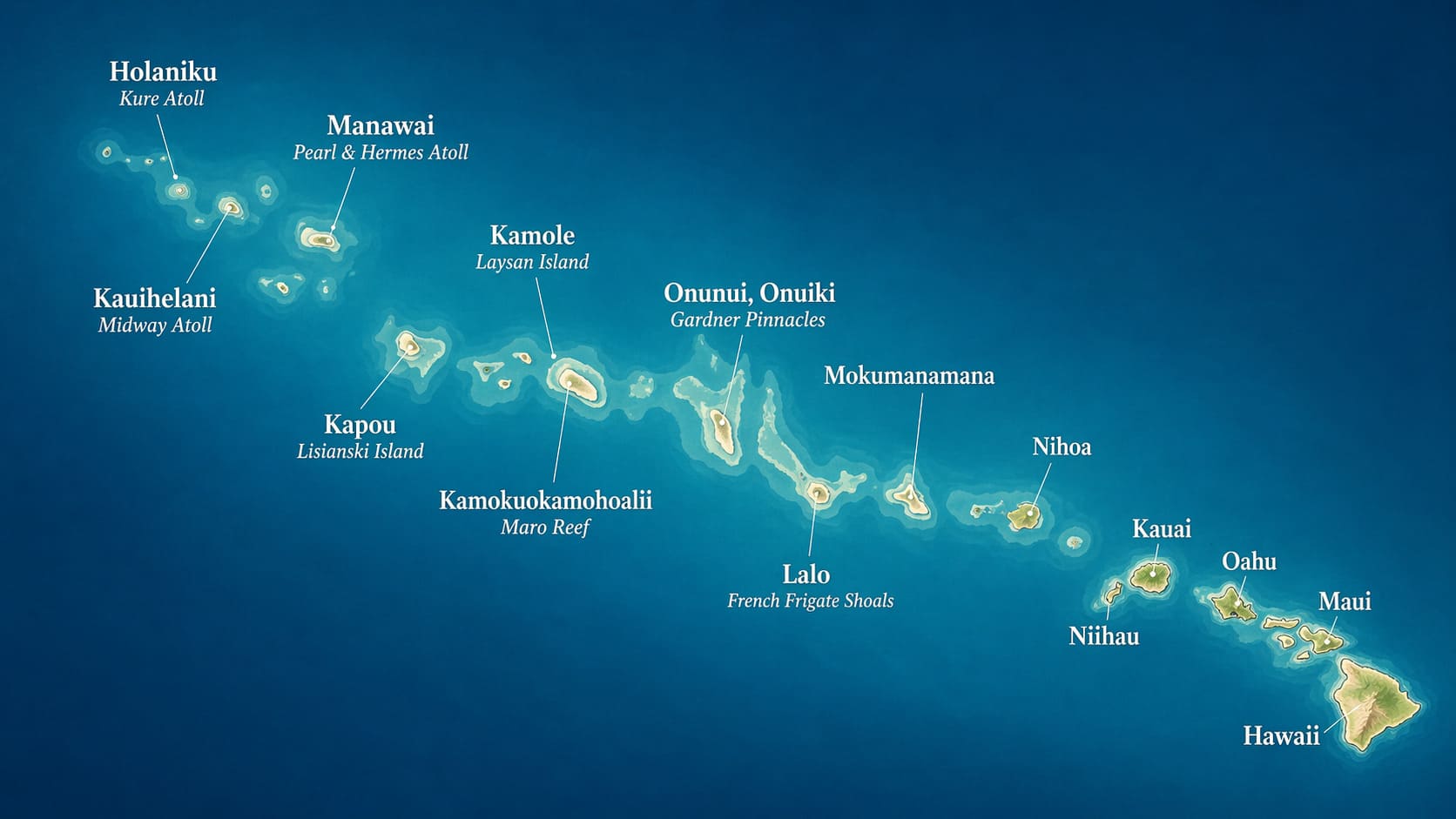
Lalo, French Frigate Shoals
French Frigate Shoals
French Frigate Shoals, or Lalo, is the largest atoll in the Northwestern Hawaiian Islands, protecting reefs, seabirds, monk seals, sea turtles and World War II history.
NASA
Encompassing 0.096 square miles (0.249 km²) of land, the French Frigate Shoals (Mokupāpapa) are comprised of about a dozen small islands, a 20-mile (32 km) long crescent-shaped reef, 12 sandbars and the 120 feet (36 m) high La Perouse Pinnacle, the only remains of the shoals' volcanic origins. They are about
560 miles (902 km) northwest of Honolulu.
The French Frigate Shoals were named after French explorer Jean-François de La Pérouse, who almost lost two frigates when trying to navigate the shoals. There is no evidence of extensive human activity or presence on the shoals, but it is believed that the earliest human visitor to the French Frigate Shoals came from the larger Hawaiian islands in the south, which were settled by Polynesians between 1100 and 1300 AD.
In the late 1800s, American and European companies became interested in the possibility of mining guano in the Hawaiian Islands. In 1894, the Republic of Hawaii leased the French Frigate Shoals and also some of the neighbor islands (Kure Atoll, Midway Atoll and Pearl and Hermes Reef) for 25 years to the North Pacific Phosphate and Fertilizer Company. However, it was found that the guano and phosphate deposits
at the French Frigate Shoals were impractical to mine.
On July 7, 1898, Hawaii became a U.S. Territory and the French Frigate Shoals were included among the islands acquired by the U.S. During World War II (in the early months of the U.S.-Japanese conflict), Japanese seaplanes sometimes used the French Frigate Shoals to refuel by submarine. But by mid-1942, U.S. naval activity increased in the area preventing further Japanese use. After the Battle of Midway, which took place from June 4, 1942, to June 7, 1942, the U.S. Navy built a Naval Air Station on Tern Island, which has a land area of 26.014 acres (10.527 ha).
They enlarged Tern Island enough to support a 3,300-foot-long (1,005 m) landing strip. The main purpose of this runway was for emergency landings for planes flying between Hawaii and the Midway Atoll. Up until today, the original seawall, runway and some of the buildings remain. The island is now maintained as a field station in the
Hawaiian Islands National Wildlife Refuge by the United States Fish and Wildlife Service. In 2000, the French Frigate Shoals became part of the Northwestern Hawaiian Islands Coral Reef Ecosystem Reserve, which in 2006 was incorporated into the Northwestern Hawaiian Islands National Monument.
There's a submerged island in the French Frigate Shoals - Whale-Skate Island – which suffered a lot of erosion beginning in the 1960s. By the late 1990s, it was completely washed over.
The French Frigate Shoals are home to 41 species of stony corals, including some that are not even found in the Main Hawaiian Islands. Furthermore, the reef supports a large variety of fish. The masked angelfish (Genicanthus personatus), for example, is endemic to the Hawaiian Islands and is very common here. Also, more then 600 species of marine invertebrates, many of which are endemic (are not found anywhere
else in the world), live here, plus more than 150 species of algae. Many of the endangered Hawaiian green sea turtles come here to nest, and the shoals also provide refuge to the largest surviving population of Hawaiian monk seals.
In addition to the marine life, the French Frigate Shoals are home to 18 species of seabirds, including the Laysan Albatross, Black-footed Albatross, Bonin Petrel, Bulwer's Petrel, Tristram's Storm-petrel, Wedge-tailed Shearwater, Christmas Shearwater, Red-tailed Tropicbird, Masked Booby, Red-footed Booby, Brown Booby, Great Frigatebird, Gray-backed Tern, Sooty Tern, Brown Noddy, Blue-gray Noddy, Black Noddy and White Tern. Several species of shorebirds also winter here.
In a three-week research mission conducted by the National Oceanic & Atmospheric Administration (NOAA), 100 new species never seen in the area before were discovered, including many that are completely new to science.
Courtesy of Northwestern Hawaiian Islands Multi-Agency Education Project


Frequently Asked Questions
Where are French Frigate Shoals located?
French Frigate Shoals, also known as Lalo, are located about 560 miles northwest of Honolulu in the Northwestern Hawaiian Islands. They are part of Papahanaumokuakea Marine National Monument.
What makes French Frigate Shoals important?
The atoll supports Hawaiian monk seals, Hawaiian green sea turtles, seabirds, coral reefs, reef fish and many invertebrates. It is one of the most important wildlife areas in the Northwestern Hawaiian Islands.
Do sea turtles nest at French Frigate Shoals?
Yes. French Frigate Shoals are the main nesting area for Hawaiian green sea turtles. More than 90% of Hawaiian green sea turtles nest in this remote atoll region.
What is Tern Island?
Tern Island is one of the islets at French Frigate Shoals. The U.S. Navy enlarged it during World War II and built an airstrip. Today, it is associated with wildlife research, management and conservation work.
Can visitors go to French Frigate Shoals?
Public access is highly restricted. Most activities within Papahanaumokuakea require permits and are usually limited to approved research, conservation, management, cultural, education or media purposes.
Why are French Frigate Shoals vulnerable to climate change?
The atoll's low sandy islands are vulnerable to erosion, storms and sea-level rise. These changes can reduce nesting and resting habitat for sea turtles, monk seals and seabirds.