

How Islands Grow and Age
Hawaiian Volcanoes Life Stages
Hawaiian volcanoes pass through long geologic stages, from deep submarine growth to shield-building eruptions, postshield activity, erosion and occasional rejuvenated volcanism.
It is a law of nature that when something begins, it ends one day, sooner or later. Just like everything else, the Hawaiian volcanoes don't make an exception. Their existence passed through three development stages - birth, maturity and old age.
The Birth of Hawaii's Volcanoes
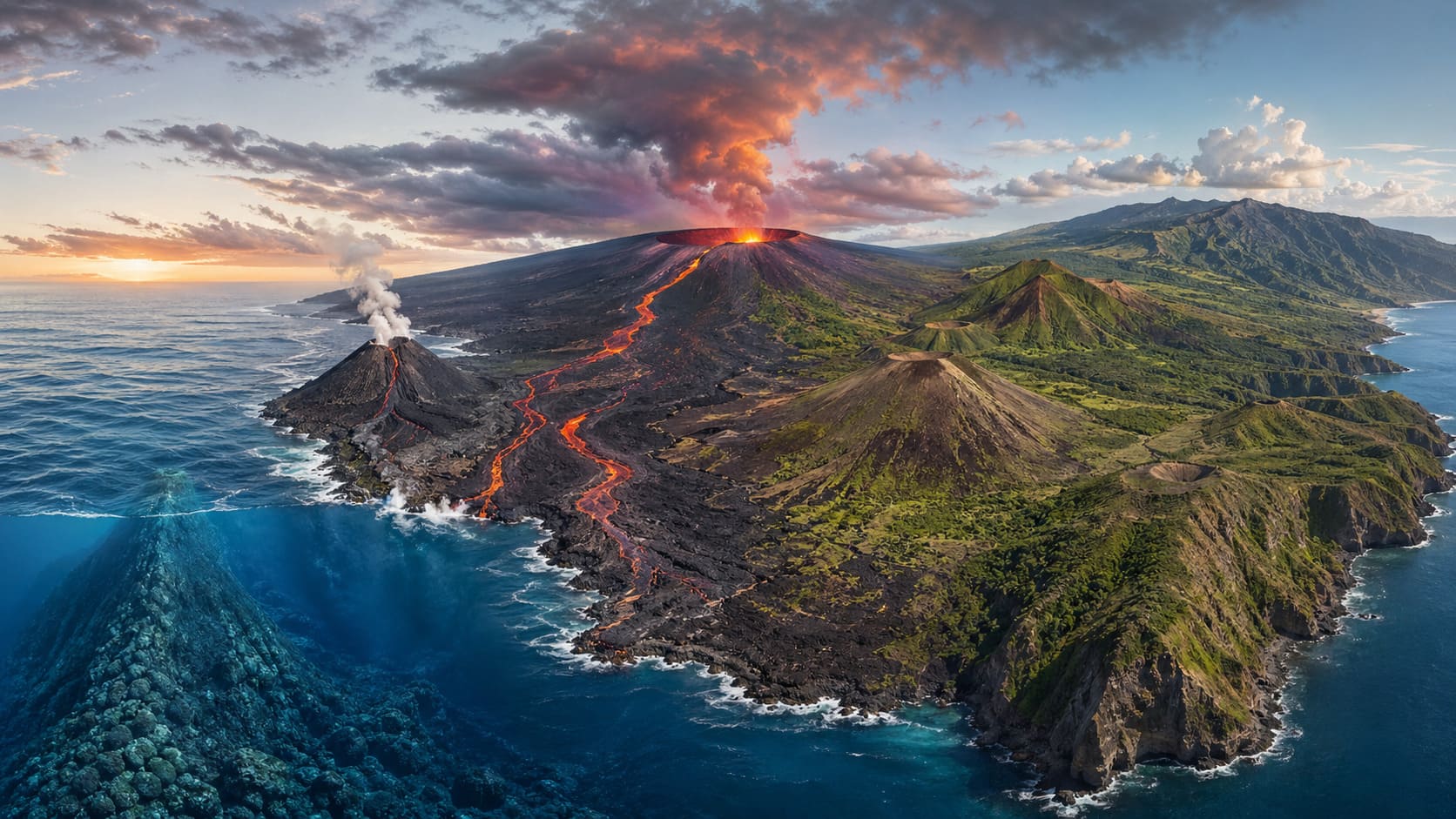
The Hawaiian volcanoes' birthplace is known to be 2.5 to 3 miles (4 to 5 km) under the ocean's surface. The outpouring of the lava created underwater mounds that were coming closer and closer to the surface as years went by. This process of outpouring was slow and lasted for thousands of years.
When the volcano is within at about 330 feet (100 m) of the surface, it produces steam explosions that throw ash in the air. The volcano continues its eruption activities and it grows as a mountain above the surface. It is known that the oldest of Hawaii's volcanoes, Kohala Volcano, has broken the surface of the ocean exactly in this manner million of years ago.
Scientists have found that about 15.5 miles (25 km) south of the Big Island of Hawaii, another volcano has started to form. Its seamount is slowly coming closer to the surface. However, the newly forming Hawaiian volcano it is not expected to break the ocean's surface within the next few thousands of years.
Although it is difficult to determine the length of the Hawaiian volcanoes youth stages, there are specific signs that can tell when they are about to end. The tops of most Hawaiian volcanoes collapse and form large craters, known as calderas.
Maturity - the Caldera's Stage
The volcanoes' maturity, also known as the caldera stage, is characterized by many volcanic activities, such as repeated collapses and refilling of the volcanoes' calderas. The length of this age lasts for thousands of years. Mauna Loa and Kilauea on the Big Island are now in this stage.
The process of caldera forming is not known in detail, and there are not many explanations about why the activity of this stage comes gradually to its end. However, it is assumed that it is related to the cooling of the magma, which leads to a decrease of volcanic activity. Toward the end of this stage, the caldera gradually fills, and at the end it completely vanishes.

Volcanoes Old Age
The volcano is in its old stage when the caldera is filled and when the top of the shield is covered with a sleepy cod. As the age of the volcano increases, the lava's chemical components start to change and contain different substances, rich in sodium and potassium.
Mauna Kea and Haleakala have gone through this stage and the different types of rocks appearing along the old ones attest that. Usually, old-age eruptions form steep cinder cones and are more explosive than eruptions in the earlier stages. For other volcanoes, such as Kahala, the eruption activities stop for thousands of years and then start again and create completely different types of rocks.
Frequently Asked Questions
What are the life stages of a Hawaiian volcano?
Hawaiian volcanoes generally pass through preshield, shield, postshield, erosional or dormant, and sometimes rejuvenated stages.
Where do Hawaiian volcanoes begin?
Hawaiian volcanoes begin deep beneath the ocean as submarine volcanoes. Repeated lava eruptions build seamounts that may eventually rise above sea level.
What is the shield stage?
The shield stage is the main growth phase, when frequent eruptions of fluid basalt lava build a broad, gently sloping volcano.
Which Hawaiian volcanoes are in the active shield stage?
Kilauea and Mauna Loa are the most active Hawaiian volcanoes today and continue to produce eruptions in the Big Island region.
What is the postshield stage?
The postshield stage happens after the main shield-building phase. Eruptions become less frequent, lava chemistry may change and cinder cones or thicker lava flows may form.
What is rejuvenated volcanism?
Rejuvenated volcanism is a late stage when an older volcano erupts again after a long quiet period, often creating small cones, vents or lava flows.
Is Kama'ehuakanaloa a new Hawaiian island?
Not yet. Kama'ehuakanaloa is an active undersea volcano southeast of the Big Island. It may rise above sea level far in the future, but that could take many thousands of years.
Are Mauna Kea and Haleakala extinct?
No. USGS classifies Mauna Kea and Haleakala as active because they erupted within the past 10,000 years and have the potential to erupt again.
Why do older Hawaiian islands look so different?
Older islands have moved away from the hot spot and have had more time for rain, waves, streams, wind and landslides to carve valleys, cliffs and ridges.