

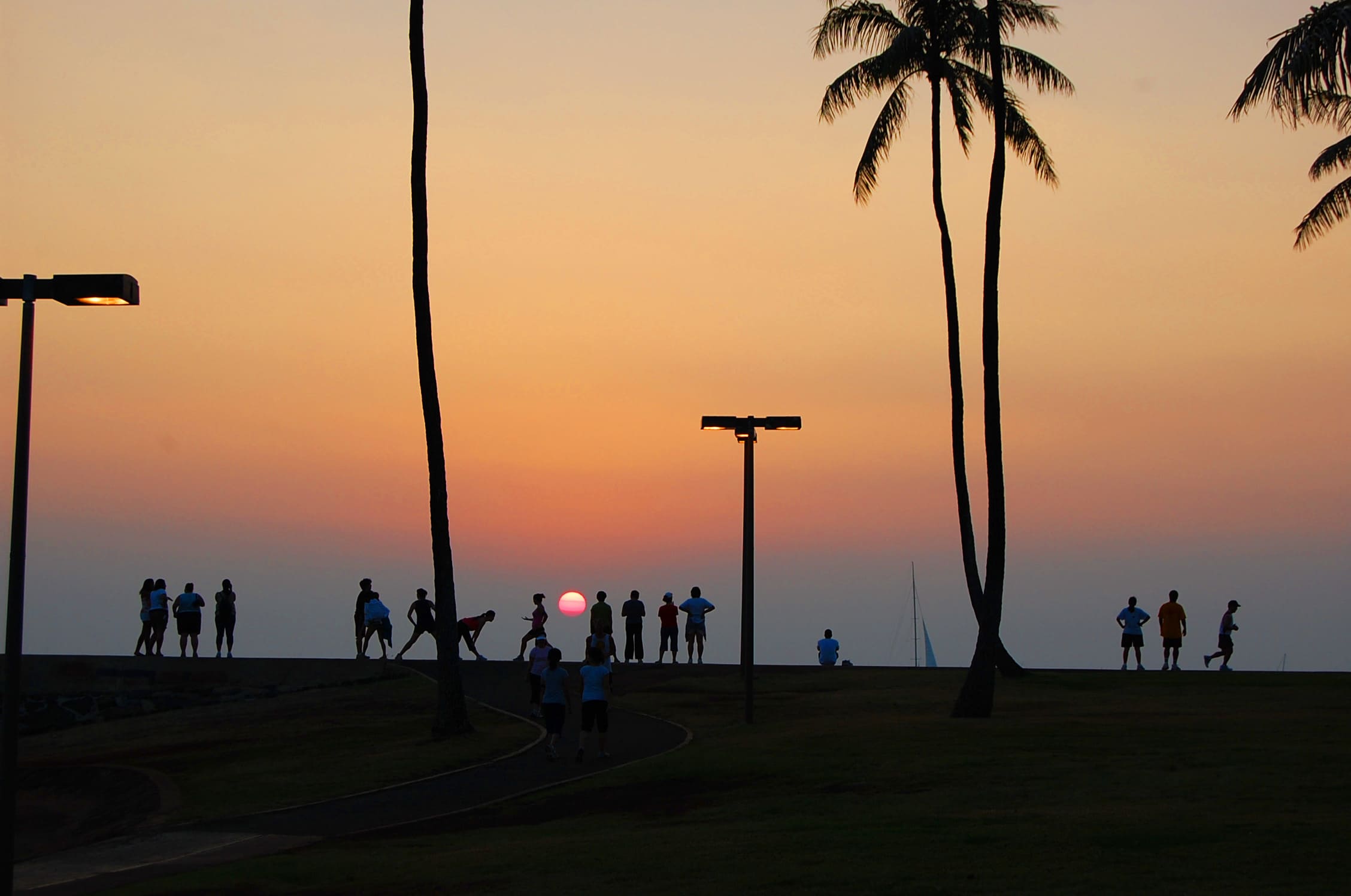
Volcanic Haze in Hawai'i
Hawaiian Vog
Hawaiian vog forms when volcanic gases from Kilauea react with sunlight, oxygen and moisture in the air. This hazy volcanic smog can affect visibility, sunsets and breathing comfort, especially on Hawai'i Island when winds carry emissions across the landscape.
Voggie sunset at Magic Island
Vog over Waikiki
Vog over Honolulu
Vog is air pollution caused by active volcanoes (the name comes from ‘volcanic smog’). The volcanoes in Hawaii emit sulfur dioxide into the atmosphere, which reacts with other gases, moisture, dust and sunlight to form vog.
The most severely affected region is the western part of the Big Island of Hawaii because the tradewinds (which blow from the northeast on most days of the year) carry the vog around the mountains, where it then collects in the western regions on the island. In Hawaii, the gas plumes of Kilauea rise up from three locations: Halema'uma'u Crater, Pu'u 'O'o vent and from along the coastline where lava flows from the east rift zone enter the ocean.
In general, the Big Island has higher levels than elsewhere, and the area around Kailua-Kona is often the most heavily affected. Areas from Volcano Village to Hilo can also experience high levels of vog.
Many people don’t notice vog in low levels. The volcanic fog is most noticeable when driving through the Hawaii Volcanoes National Park. The sky appears hazy and the horizon is obscured.
Vog levels range from light to extreme (where objects less than a mile away appear to have a blue/grey tint). Some people may have more sensitivity to vog than others – reactions can include a build-up of mucus, difficulty breathing, headache and sore throat. Vog is mostly a concern for people who already suffer from asthma and other respiratory conditions.
Vog exposure generally increases with altitude, so the amount of exposure at sea level is the lowest. Vog is most present from 300 – 6,000 ft. (91 – 1,829 m), with the area around 1,000 ft. (305 m) experiencing the most. Above 6,000 ft., vog emissions decrease rapidly.
It is impossible to forecast a raise in vog levels, as emissions can increase dramatically without warning, and levels are dependent on variable winds and weather patterns. For people who may be subjected to high levels of vog, the government recommends drinking plenty of bottled water, staying indoors, and if using an air-conditioner, to keep the vent closed and use re-circulated air if possible.


Frequently Asked Questions
What is Hawaiian vog?
Hawaiian vog is volcanic smog that forms when sulfur dioxide and other volcanic gases react with sunlight, oxygen, moisture and particles in the air.
Where is vog most common in Hawai'i?
Vog is most common on Hawai'i Island because it sits closest to Kilauea. The Kailua-Kona area and other downwind districts can experience hazy conditions when winds carry volcanic emissions across the island.
Is vog harmful to breathe?
Low levels may not bother most people, but vog can irritate the throat, eyes and lungs. People with asthma, COPD, heart disease or other respiratory conditions may feel symptoms more strongly.
Can vog affect other Hawaiian Islands?
Yes. Vog usually affects Hawai'i Island the most, but changing winds can carry haze and fine particles to Maui, O'ahu and other islands at times.
How can I protect myself from vog?
Stay indoors during heavy vog, close windows and doors, use air conditioning on recirculate mode, avoid heavy outdoor activity and monitor local air quality if you have breathing concerns.
Can vog levels be forecast?
Vog can be estimated with air-quality monitors and forecast models, but exact conditions are hard to predict because volcanic emissions and wind patterns can change quickly.
Is vog the same as laze?
No. Vog forms from volcanic gases in the air. Laze forms when hot lava enters the ocean and creates an acidic steam plume with tiny volcanic glass particles.