
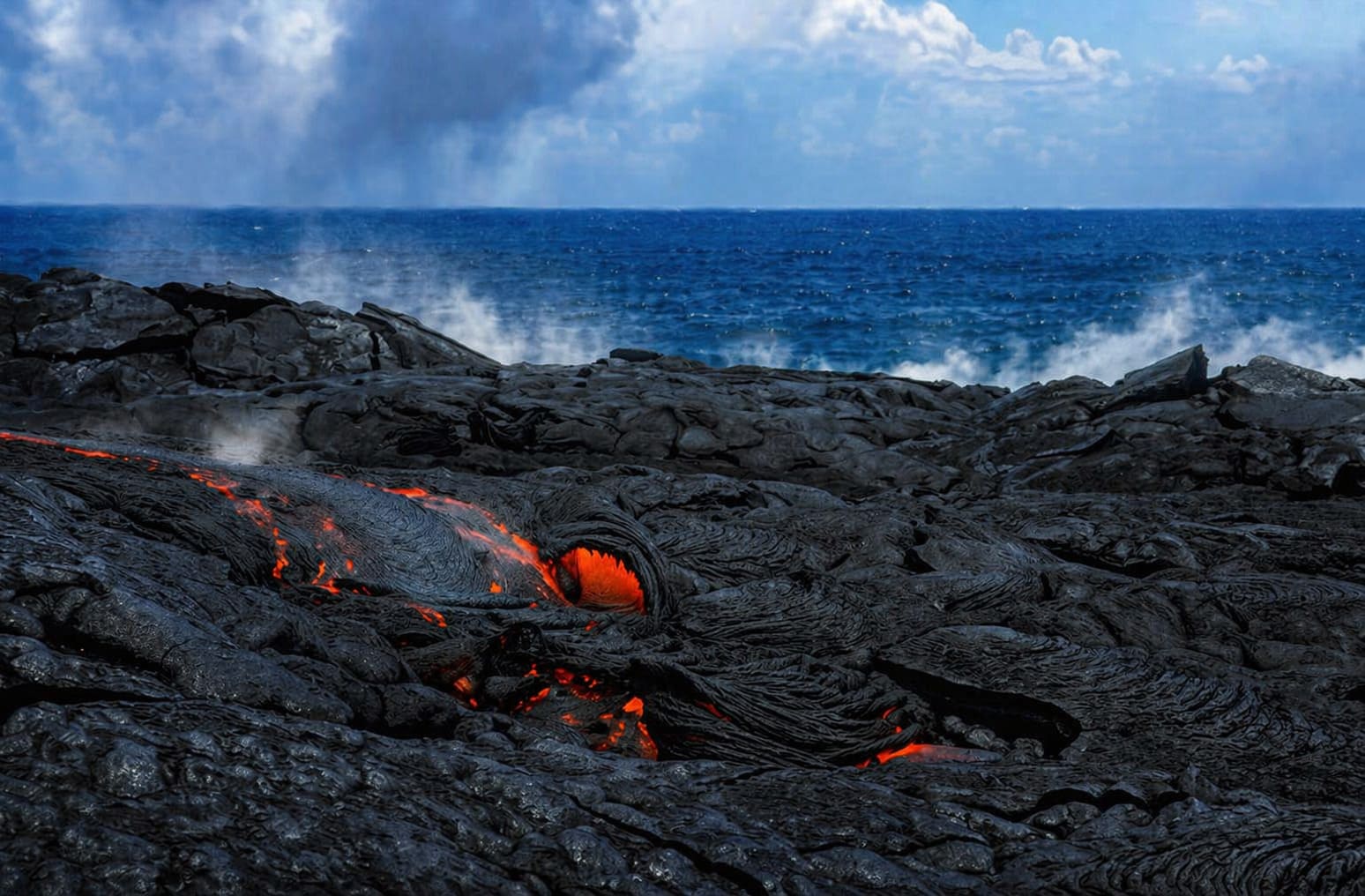

The abundance of active volcanoes on the Big Island of Hawaii means that lava is a prominent feature of the island's landscape. The Big Island is the youngest island in the Hawaiian archipelago and the only island that is still growing in size when new lava reaches the surface and forms land. A series of earthquakes can accompany eruptions, where fissures allow magma to reach the Earth's surface. One of the features of Hawaiian lava flows is that they are often relatively quiet compared with some other volcanic regions, because the lava is fluid and gases can escape more readily.
Given its liquid nature, the lava in Hawaii is less likely to turn into ash or cinders as it escapes from deep within the Earth, which has resulted in floods of molten lava down the mountainsides. Eruptions here have lasted from a few days to many months, and sometimes much longer during major eruptive episodes. Hawaiian lava can be extremely hot, with lava in tubes reaching about 2,200°F (1,250°C).
Hawaii has two typical surface types of lava flows: 'a'a and pahoehoe. An 'a'a lava flow is typically blocky, can be 3-20 meters (9.8-65.6 ft) thick and rolls over itself across the ground like a tank track. The jagged front of the flow typically creeps forward and gets higher and higher until a section becomes unstable and breaks off, revealing the glowing central core. This lava flow has pointed and jagged blocks with dangerously sharp edges and spiny projections.
Pahoehoe in Hawaiian means "ropy," and this term is used to refer to basaltic lava that has a smooth, hummocky or ropy surface. Pahoehoe is formed as a layer of skin covers the underlying liquid lava and the movement of the continued lava flow below begins to wrinkle the surface, creating a ropy or billowy appearance. The unusual shapes on the surface of pahoehoe lava flows are often referred to as lava sculpture. Pahoehoe lava flows are thinner than 'a'a flows and are sometimes only 30-50 centimeters (11.8-19.7 inches) thick.
Some lava flows emerge from the vent as pahoehoe and change to 'a'a, never the other way around, as they are mixed, cooled, lose gas and increase in crystallization. As soon as a crust has formed on a pahoehoe flow, lava tubes below it continue to move the remaining liquid for long periods of time. The size of the tubes ranges from only a few inches to many feet in diameter.
When the source of lava stops, the liquid keeps on draining, leaving lava tubes or caves. These lava tubes can extend for several kilometers, as they do in Hawaii. Lava tubes are an efficient way for lava to travel long distances without significant cooling.
Lava flows can have many features depending on the rate at which they cool. One of the simplest formations is a spatter cone, a steep, conical hill formed of molten lava ejected from a vent, which splashes down and over the sides of the developing mound. Spatter cones are often found in Hawaii because of the particularly fluid magma.
Another feature of the Hawaiian landscape formed by lava is lava lakes. These are large volumes of molten lava contained in a vent, crater or broad depression. Scientists use the term to describe both lava lakes that are molten and those that are partly or completely solidified.
Ocean Entries and Lava Safety
When lava reaches the ocean, it can create steam, new land and serious hazards. Ocean entries may look dramatic from a distance, but they can produce explosions, acidic fumes, glassy particles, scalding waves and unstable lava benches that can collapse without warning.
Visitors should never cross closed areas, approach active lava, enter unstable lava fields, or get close to an ocean entry by land or sea. Active lava viewing changes often and is never guaranteed. Before planning a lava-viewing trip, check current Hawaii Volcanoes National Park and USGS updates and follow all posted signs, ranger guidance and emergency instructions.


